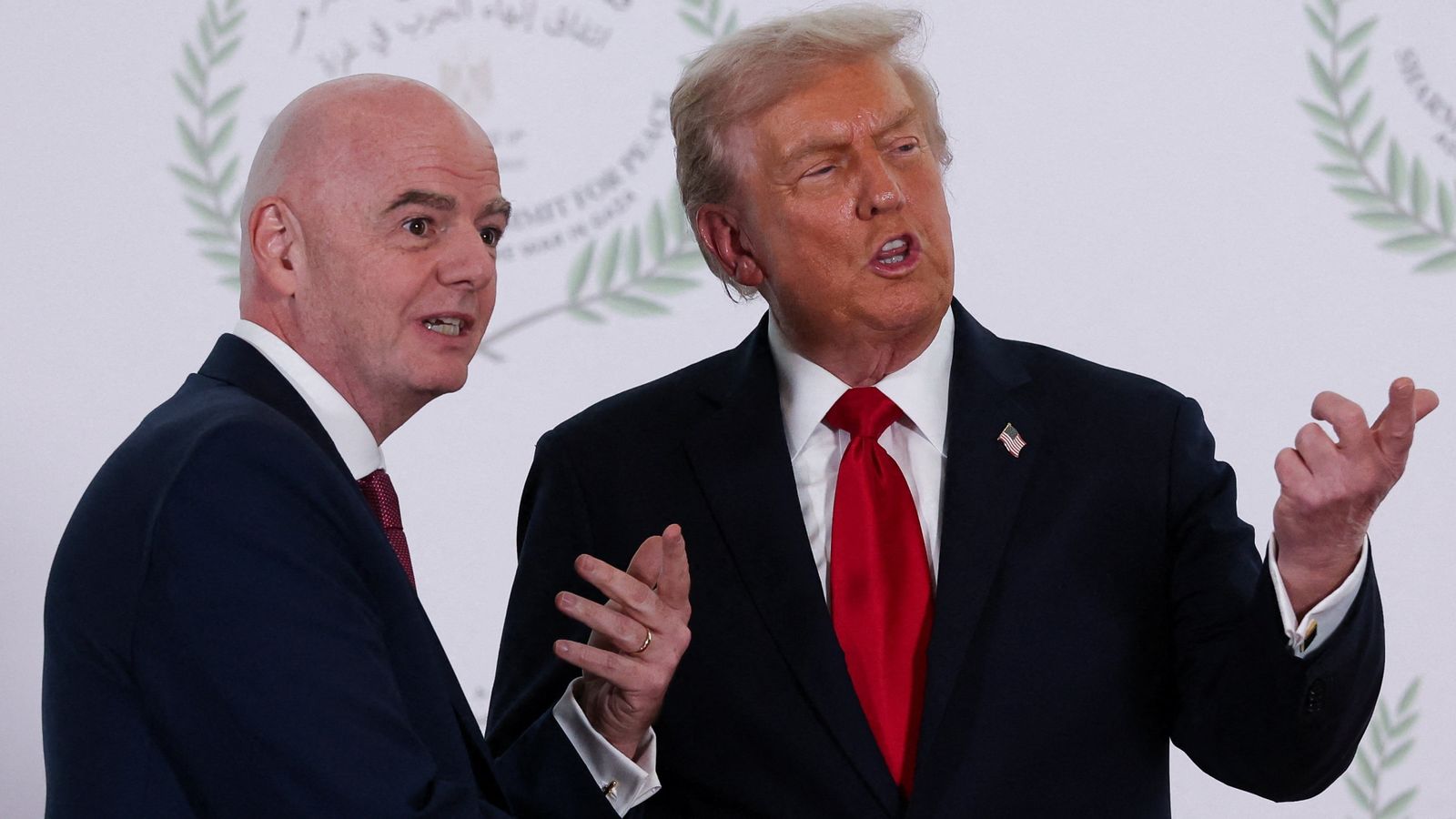
United States president Donald Trump has given his blessing to Iran competing on his country’s soil during this summer’s World Cup, stating: “Let them play.”
Iran's participation has been the subject of uncertainty since the US and Israel launched air strikes on the country on February 28.
FIFA president Gianni Infantino has repeatedly insisted Iran would play as scheduled, with all three of their group games taking place in the US, and confirmed again at FIFA's congress on Thursday.
Trump was asked about Infantino's comments in a media briefing later on Thursday, and said: "Well if Gianni said it, I'm OK.
"Did Gianni say it? Gianni Infantino - that's a piece of work."
Asked what would happen if Iran won, Trump replied: "If they win we'll have to worry about that. I'm going to have to worry about that one.
"You know what, let them play. Gianni is fantastic, he's a friend of mine, he talked about it, I said, 'you do whatever you want'.
"You can have them, you don't have to have them, they probably have a good team. Do they have a good team, do you have any idea?"
The reporter who posed the initial question said he had no idea.
Trump replied: "It would be hard to believe actually. But let them play, right?"
Iran would face the US in the last 32 in Dallas if both teams finished second in their respective groups.
Trump has previously said it would be "inappropriate" for Iran to play "for their own life and safety".
Infantino opened his president's address at congress in Vancouver: "Let me start at the outset by confirming straight away, for those who maybe want to say something else or write something else, that of course Iran will be participating at the FIFA World Cup 2026.
"And of course, Iran will play in the United States of America. The reason for that is simple, because we have to unite. We have to bring people together."
Iran will kick-off their campaign against New Zealand in Los Angeles on June 15.
Iran were the only one of FIFA's 211 member nations not represented by federation officials in Vancouver.
Meanwhile, Palestinian Football Association (PFA) president Jibril Rajoub refused to stand alongside Israel FA vice-president Basim Sheikh Suliman in a heated moment at the FIFA congress.
Both men were called to the stand by Infantino but Rajoub declined to be brought closer to Arab-Israeli Suliman.
Infantino put his hand on Rajoub's arm and invited him with a gesture to come closer to Suliman, but in vain.
Asked what Rajoub said when he refused, Palestinian FA vice-president Susan Shalabi, who was in the room, told Reuters: "I cannot shake the hand of someone the Israelis have brought to whitewash their fascism and genocide! We are suffering."
Israel has denied committing genocide in Gaza.
Infantino then took the stand and said: "We will work together, president Rajoub, vice-president Suliman. Let's work together to give hope to the children. These are complex matters."
Speaking to Reuters after the congress ended, Shalabi said Infantino's attempt to have Suliman and Rajoub shake hands showed little consideration for the Palestinian FA chief's speech, in which he made yet another plea for Israeli clubs not to base teams in the West Bank settlements.
"To be put in a position where you have a handshake after everything that was said, this negates the whole purpose of the speech that the general [Rajoub] was giving," she said.
"He spent like 15 minutes trying to explain to everyone how the rules matter, how this could easily become a precedent where the rights of member associations are violated with impudence, and then we'll just wrap this under the carpet. It was absurd."
Last week, the PFA appealed to the Court of Arbitration for Sport against FIFA's decision not to sanction Israel over clubs based in West Bank settlements.
The PFA has long argued that clubs based in settlements in the West Bank - territory Palestinians seek as part of a future state - should not compete in leagues run by the Israel Football Association.
FIFA said last month it would take no action against the IFA or Israeli clubs, citing the unresolved legal status of the West Bank under public international law.
Associations will be invited to vote for FIFA's next president at the 2027 congress, and Infantino closed by announcing that he will stand for re-election.
Winning a third full four-year term is likely to be a formality for Infantino at next year's congress in Morocco. It would mean he would remain president until 2031 and he would be in charge for the centenary 2030 World Cup in Spain, Portugal and Morocco.
It would also mean that by the end of his final term he would have been president for 15 years - only two fewer years than his predecessor Sepp Blatter.
Infantino won his first term in 2016 and this should have been his final term. But FIFA's rules have been changed so only full terms count towards the three-term limit, paving the way for him to stand again next year.
Infantino won his second term by acclamation in 2019 as he was the only candidate and the rules were changed so that a vote was not required. He was re-elected again in 2023 with no vote as he was the only candidate again.
Presidents are meant to be elected by a vote of all FIFA's 211 member associations, but Infantino is so popular with federations outside Europe that his elections are a mere formality with no votes required.
Infantino set out some of the achievements of the organisation under his leadership over the last decade.
He referenced $2.7bn (£2bn) of development funding budgeted for the 2027 to 2030 cycle, an eightfold increase on the level prior to him taking office.
He also said revenue for the current cycle, 2022 to 2026, would be more than $14bn (£10.3bn), ahead of budget.
The majority of that revenue stems from this summer's World Cup finals. FIFA has faced stiff criticism for the pricing of World Cup tickets, and the decision to adopt a dynamic pricing strategy.
Infantino said: "You've heard there were many discussions about the ticketing of the World Cup.
"We had 500m ticket requests. In the last two World Cups together, we had 50m ticket requests. Here, 500m. We sold 100 per cent of the inventory that we put on the market, which is more or less 90 per cent of the global inventory so far. And of course, we are always putting tickets on the market.
"There are expensive tickets, yes, but there are also affordable tickets."
Infantino added that all revenue generated goes back into the game in distributions to member associations, and development of new and existing competitions.
"In a big majority of our countries, we could not have organised football the way we know it without the grants and the revenues and the FIFA Forward programme."
